Start with your industry.
Move directly to the outcomes and technology that fit how it operates.
Choose a sector to see solution directions grounded in its documented operating needs. Keep sector context, buyer outcomes and technology evidence distinct.
Your industry,
your starting point.
Ten canonical sectors available.
Direct means source-defined. Contextual means a discovery association described by this wireframe, not a formal product mapping.
Production mapping approvals and solution URLs were not supplied. This preview offers consultation and local industry navigation.
Choose a sector to see its operating context.
One direct specialist direction where defined, plus up to four contextual directions. No rankings or product-brand clusters.

Separate outcomes.
Connected foundations.
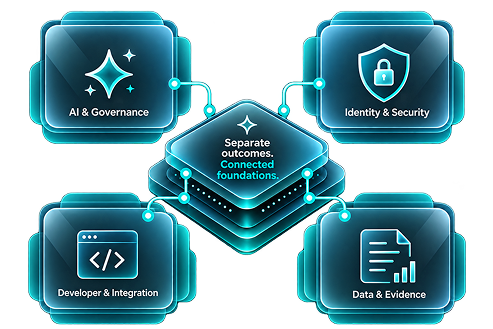
AI & governance
Source-aware assistance and accountable approvals.
Identity & security
People, systems, delegated authority and resilience.
Developer & integration
Supported interfaces, legacy coexistence and observability.
Data & evidence
Provenance, control scope and reviewed claims.
Know the problem first?
Start with the operating need.
Sector examples are discovery aids, not claims of deployment, certification or support for every scenario.
Modernize enterprise systems
Apply governed AI
Run recurring operations
Operate communications
Manage regulated workflows
Build and integrate

A translation layer.
Clear relationship classes.
Industries answer “Does Zoiko understand my sector?” Solutions answer “What problem can Zoiko help me solve?” Product evidence belongs on the destination.

Direct specialist
The source explicitly defines a named industry-outcome solution.

Contextual outcome
Documented operating needs overlap a solution proposition. This is routing logic, not an official product mapping.

Shared foundation
Cross-cutting technology and trust support the use case without becoming a sector-specific product.
From discovery to a focused
evaluation.
Choose sector → identify need → review rationale → validate destination → scope one workflow.

Scope one workflow
Identify current systems, responsible owners and the desired operating outcome.

Validate the boundaries
Confirm product readiness, operator, geography, professional authority and evidence.

Expand after review
Evaluate integration, support and operational acceptance before increasing scope.
Understand the route
before you take it.